
Waterford Township Previous Residents Sources
No single source answers every question about who lived at a Waterford Township address. The work moves era by era. Current parcel facts lead to recorded transfers, and then regional directories and census schedules add the household context. The runs are uneven. Waterford inclusion must be checked in the volume itself. Let the date of the question choose the first source, because a modern search screen does not reach every period.
| Source | Years It Covers | Where Held | What It Shows |
|---|---|---|---|
| Oakland Super Index | January 1964 to current | Online at ocmideeds.com | Recorded documents, parties, dates, Liber/Page or document number; images or actions may be paid. |
| Oakland manual, tract, and deed books | Earlier material, with some records into the 1800s | County Register of Deeds, Tract Index, and records retention | Earlier deeds, plats, surveys, mortgages, and land-description paths. |
| Pontiac-Flint directory | 1860 to 1861 | Oakland History Center | Early regional names, addresses, and business context; Waterford coverage is unconfirmed. |
| Pontiac and Polk directories | 1907, 1912, 1915; selected 1922 to 1962 runs | Oakland History Center and possible library copies | Surname, street, phone, business, and household context where included. |
| North Oakland criss-cross directories | 1957, 1958, 1960, and 1972 to 1983, with a 1974-75 gap | Oakland History Center and Library of Congress guide or local holdings | Reverse street-to-household route, with regional and coverage limits. |
| Federal census | 1790 to 1950 public under the 72-year release | National Archives, FamilySearch, and library databases | Household, relationship, age, birthplace, and district context; not always a street address. |
| Waterford permits | Current BS&A and building route; historical start not located | Waterford Development Services / BS&A | Project dates and public applicant or owner evidence, not a continuous resident roll. |
The same house can carry more than one geographic label. Waterford Township sits in Oakland County, Michigan. A directory entry may instead say Pontiac, Drayton Plains, Clintonville, or Waterford Village. It could also use another postal name. Pair every entry with its exact address wording and its date. Note any parcel or map clue too. Do this before treating it as the same place.
Waterford Township Parcel Records
Waterford Assessing publishes the registered owner at an address as a public assessment field. It covers 33,092 parcels. Alongside ownership, the office describes property descriptions, assessed and taxable values, plat-book maps, record cards, valuation reports, and sketches. Write down the situs address, parcel or PIN, registered owner, owner mailing address, legal description, and subdivision lot or metes-and-bounds wording before starting a backward search.
The situs is where the parcel sits. A mailing address is different. It shows where tax correspondence goes and can be somewhere else entirely, so treat it as a clue rather than proof of residence. Oakland County Property Gateway lets a searcher begin from a property address or PIN, use partial and wildcard forms, click the map, and reach property or tax-report paths. The static portal offers no confirmed owner-name field.
Parcel data hands off cleanly to a deed. PINs outlast street names. A parcel can later be split, combined, or converted, so keep both the current PIN and the land description in your research notes.
Trace Waterford Township Deed Records
The Oakland County Clerk/Register of Deeds Super Index is the main online link in the backward trail. Search the current owner as a grantee first. The purchase deed then names the grantor. The recorded legal description and PIN keep one parcel separate from another property tied to the same name. Then search that grantor as a grantee. Each pass locates the earlier acquisition, and the chain builds one recorded transaction at a time.
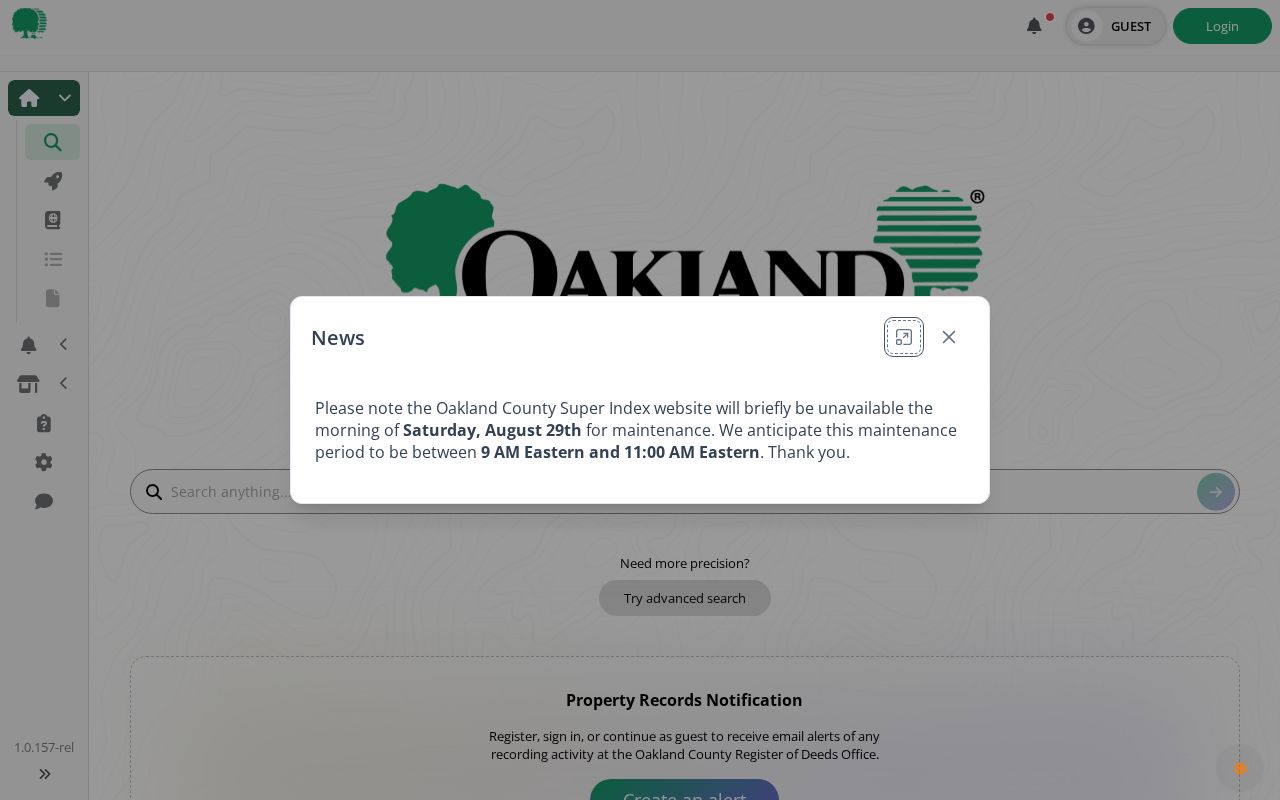
The Super Index opens the deed chain online. Its free search result is a lead only, and image, download, or ordering access can differ by document.
- Find the current Waterford Township parcel by situs address, Property Gateway, or GIS, and note its PIN and legal description.
- Search the current owner as grantee in the Super Index, narrowing with the PIN, legal description, document type, or date when available.
- Capture the grantor, grantee, recording date, consideration if shown, Liber/Page or document number, legal description, and image availability from the purchase record.
- Use the grantor as the next grantee search, trying name variants and relying on the legal description rather than a modern address alone.
- Compare lot wording and adjoining descriptions at each step because a later split, combination, plat, or condominium conversion can change the PIN.
- Request the recorded image or certified copy and ask the Register of Deeds or Tract Index to confirm the legal description when legal proof is required.
- Grantor / grantee
- The grantor transfers an interest in the record. The grantee receives that interest. In a purchase deed, those terms generally identify the seller and buyer.
- Chain of title
- The linked sequence of recorded transfers for the same land, traced from one transaction to the prior one.
- Legal description
- The land wording in a recorded instrument, such as a subdivision lot and block or metes-and-bounds description. It can survive a changed street label.
Waterford Township Deed Records Cutoff
Online coverage and land-record history are different things. Oakland's computerized Super Index begins January 1, 1964. That date starts the computerized layer, not the ownership record. Manual deed books, the Tract Index, plats, and retention material carry the county trail earlier. Some pieces reach the 1800s.
When the online index stops, the search does not. Move to the Oakland County Clerk/Register of Deeds or the Tract Index instead of treating the gap as the end. The Tract Index follows land, not names. It tracks acreage, metes-and-bounds, subdivision lots, condominiums, mortgages, surveys, and plats. Staff may be able to locate the last recorded deed, its date, and its price where available. FamilySearch Michigan wills and deeds and cataloged deed books offer a second channel. The county recording remains the confirmation point.
Note: An older land search needs the legal description, lot and block, or tract terms, because a current street address may not appear in the manual index.
Waterford Township Directory Eras
A deed can never show who lived in a house, but historical directories can. The Oakland County Pioneer and Historical Society shelf list opens with the 1860 to 1861 Pontiac-Flint City Directory. It then moves on to Pontiac titles for 1907, 1912, and 1915. It also holds selected Polk's Pontiac runs from 1922 through 1962. A 1930 Arrow Street Guide and a 1931 telephone directory sit alongside them. North Oakland Criss-Cross volumes cover 1957, 1958, and 1960. Bresser's South Oakland Cross-Index reaches 1967 to 1968.
The Library of Congress criss-cross directory guide carries Pontiac and North Oakland County volumes for 1972 through 1983. The 1974-75 volume is missing from the sequence. That gap matters. These titles are not an unbroken annual record. Anyone tracing past residents of Waterford Township should open the regional volume. That confirms the street address actually appears.
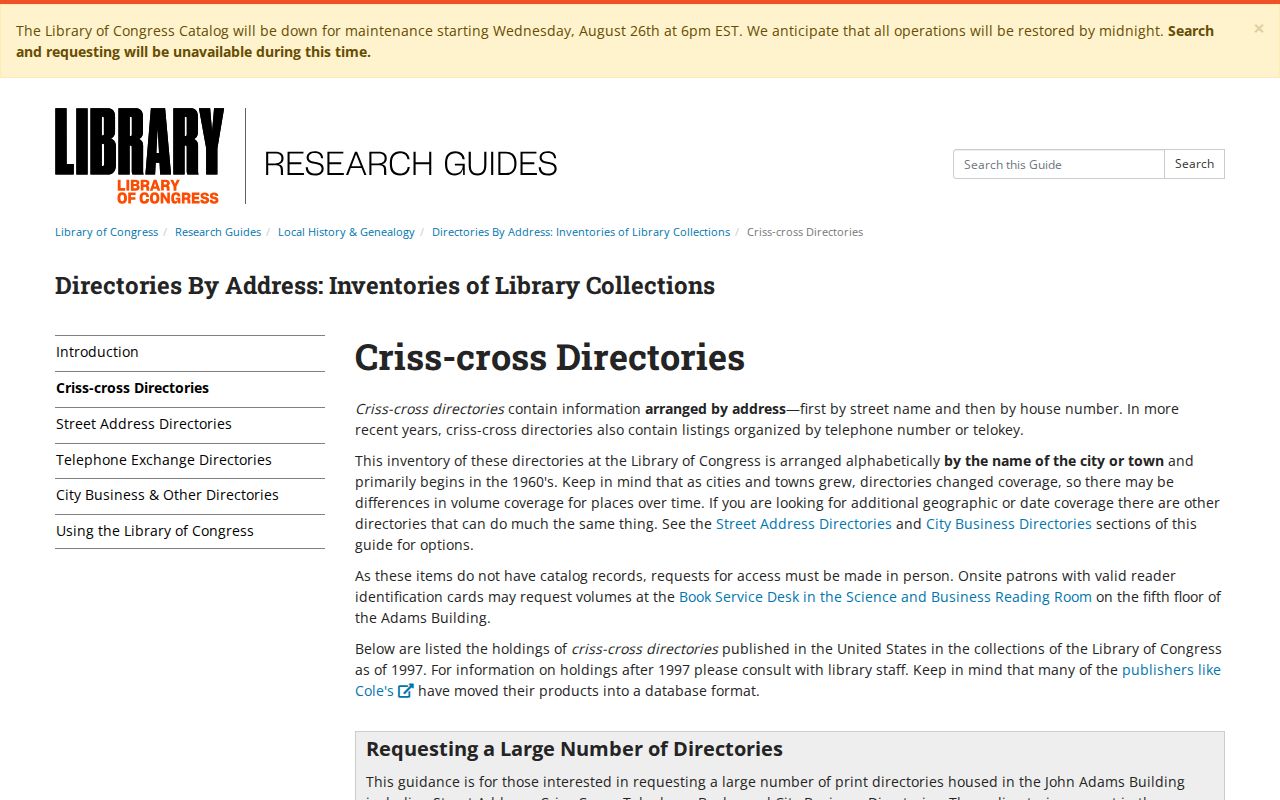
A criss-cross guide opens the door to an address-first historical lookup. Read the volume's abbreviations and geographic scope first. Only then transcribe the household name.
The historical directory collections themselves are cataloged on the Waterford Township city directory page. Work one volume at a time for an address trail, then return to the parcel and deed records for independent support.
Waterford Township Census Records
Federal census schedules opened by the 72-year rule, reaching from 1790 through 1950, give a past-residents search real substance. A household entry can carry names, relationships, ages, birthplaces, and occupations. That detail often beats a name-only match. What a census lacks, though, is street precision; an enumeration district in a rural or fast-changing area will not read like a reverse directory. Treat each page as a dated household record, then test the address geography against maps and land records before trusting it.
Match records, not just names. Ages and birthplaces anchor a household. Addresses anchor a place. When both agree, the trail holds.
- Find the address in the closest available directory or criss-cross volume and transcribe its spelling, number, and abbreviations.
- Check the nearest public census year for a household with the same community, age, family, and geographic clues.
- Compare the census district with the township map, parcel, road names, and nearby addresses.
- Return to a deed, permit, obituary, or probate record for a date that anchors the household to the property.
Waterford's local history leans on several community labels at once. The population shift recorded between 1920 and 1930, in other words, does not equal a clean list of households moving in or out. Boundary changes, development, and the way enumerators worked can each shape both the counts and the labels inside a census record.
Waterford Township Street Records History
Road-name continuity is a quirk that trips up past residents research in Waterford Township. The local timeline shows Grand River street becoming Maple, and later Andersonville Road. Old records add more layers. A historical directory, obituary, or deed may instead say Drayton Plains, Clintonville, Waterford Village, Windiate Park, Pontiac, or a postal name. That name never matched the current situs line. Keep both forms of the address side by side. Then test the translation with a legal description, a plat, an intersection, or a neighboring road.
Waterford historical maps help here. The 1872 views cover Waterford, Clintonville, Drayton Plains, Waterford Village, and the township. They make practical aids for decoding a nineteenth-century place label. The township publishes no comprehensive street-renumbering year. Assign one only when a record proves it.
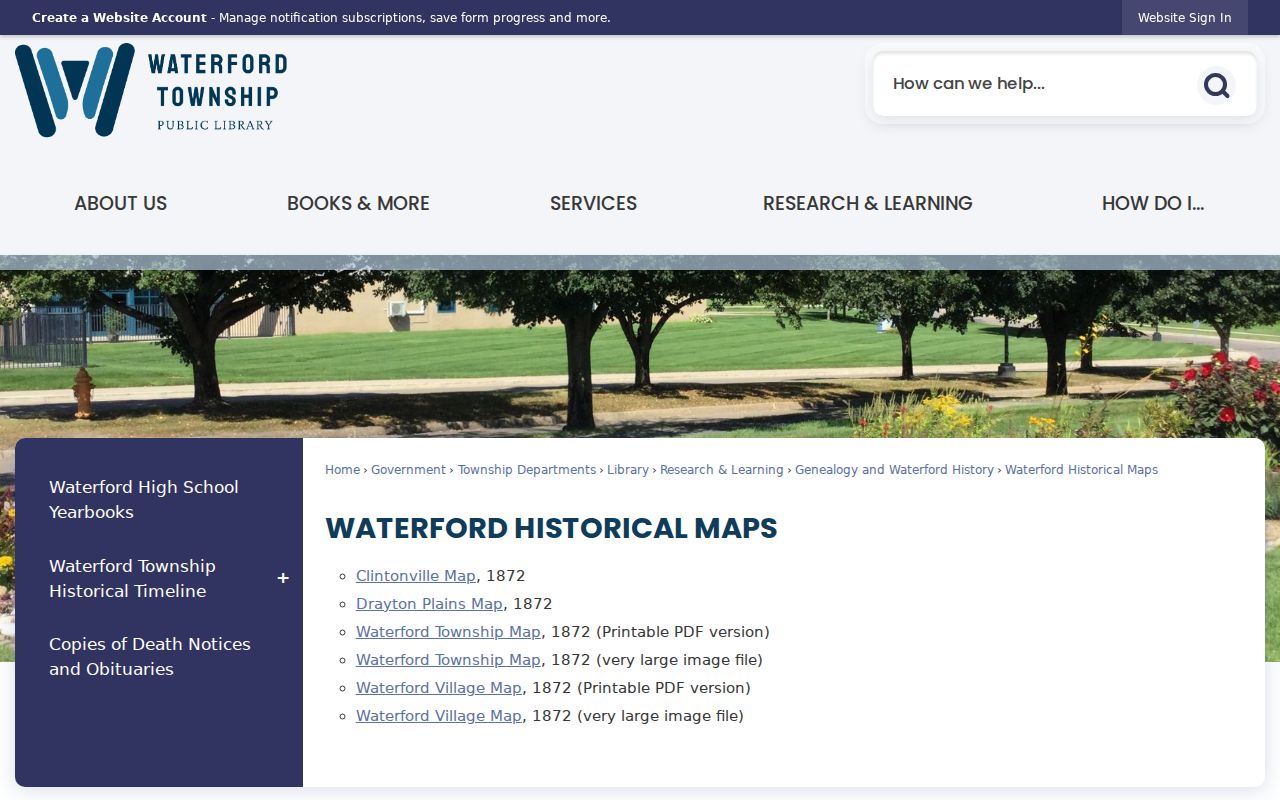
Before treating a present-day parcel search as a match, test the place-name or road-name change against the township map collection. That one step prevents most false matches.
Waterford Township House-History Records
Waterford Public Library genealogy and history resources gather historical maps, death notices, a cemetery search, census sources, yearbooks, and local biographies. FamilySearch Affiliate access joins them in one place. No separate Waterford house-history guide or paid service appears among the official material. That gap actually helps. Build the trail from recorded sources. Don't wait for a finished report on a property.
The Waterford Township Historical Society runs a research library. It sits at Fish Hatchery Park, 4490 Hatchery Road. Its Hatchery House library lists Wednesday hours, 10:30 to 2, April through mid-December. Local maps, aerials, and history books are on hand there. Referrals can tie a changed address to a community name or an older parcel context.
Pontiac Sanborn material works as a limited companion. Library of Congress and HABS sets document Pontiac for 1903, 1909, 1915, 1919, and 1924. The collection includes a 40-sheet 1919 resource. Those sheets stay Pontiac-centered. They do not prove coverage of every rural Waterford parcel. For Waterford addresses, lean on the 1872 township maps. Oakland aerials, plats, and parcel maps help instead.
Waterford Township Previous Resident Endpoints
A record trail can end with a dated event rather than another address listing. Waterford permits date construction, alteration, demolition, utility work, or a change of use. Compare the permit date with the deed recording and the directory appearance. An applicant or contractor is not always the owner or resident. The township publishes no fixed historical cutoff for online permits. Use Waterford BS&A Online or a direct township request for the period in question.
Obituaries supply a death date and relatives. They also give funeral-home details, cemetery, and often a former or current address. Oakland Probate Access adds estate, heir, fiduciary, guardian, conservator, and filing context; genealogy searching needs a last name and an approximate death year, and copies of public files can be ordered. Waterford's grave search spans five township cemeteries and sometimes includes marker or obituary photographs. A burial spot alone proves no last address. Match it with an obituary or probate file.
Waterford Township Previous Residents Limits
No single official list holds Waterford Township's previous residents. Ownership, a directory line, a census household, a permit party, and an obituary each capture a different moment. Each also reflects a different relationship to the property. Gaps are normal. Timing, geographic scope, a renamed road, a missing directory year, a household that never subscribed, or protected information can all explain a mismatch. Someone may appear in one source and not another for any of these reasons. Confirm the date and the address across more than one record before calling a match reliable.
Michigan privacy rules still apply, including the Michigan Address Confidentiality Program for qualifying participants. When a township-held historical record sits offline, file a targeted written request under the Michigan Freedom of Information Act rather than asking for a broad address list. Use these records for lawful ends: house history, family research, estate work, safety, or civic understanding. Never use them to track, harass, or harm a living person.
Lawful use. Keep Waterford Township house-history research focused on the property and its documented past. Do not use historical records to intrude on a person's privacy.